Physiotherapeutic Scoliosis Specific Exercises (PSSE)
Evidence-based, curve-specific scoliosis rehabilitation using the internationally recognized Schroth Best Practice Method — delivered by a SOSORT-member, ISICO-trained physical therapist in Youngsville, NC.
Understanding Your Treatment
A Specialized, Science-Backed Approach to Non-Surgical Scoliosis Management
Physiotherapeutic Scoliosis Specific Exercises commonly known as PSSE are a specialized category of therapeutic exercises developed specifically for the assessment and treatment of scoliosis. Unlike general physical therapy or standard core exercises, PSSE programs are individually designed around each patient's unique spinal curve type, location, and severity.
At Polaris Rehabilitation, we use the Schroth Best Practice Method one of the most extensively researched and internationally recognized PSSE approaches available. DDeveloped in Germany and endorsed by SOSORT (the International Society on
Scoliosis Orthopedic and Rehabilitation Treatment), the Schroth Method uses a
three-dimensional approach to scoliosis correction, addressing the rotation,
lateral curvature, and sagittal imbalance of the spine simultaneously.
The goal of PSSE is not simply to strengthen the back it is to teach the patient how to actively correct their own posture, breathing mechanics, and spinal alignment in ways that are specific to their individual curve pattern. With consistent practice, patients can slow or halt curve progression, improve posture, reduce pain, and enhance overall spinal function — all without surgery.
Our physical therapist, Alma Deguzman PT, DPT, C.Ped, is certified in the Schroth Best Practice Method, has completed advanced training through the Italian Scientific Spine Institute (ISICO), and is an active member of SOSORT ensuring every patient receives the most current, evidence-based PSSE care available in North Carolina.
Is PSSE Right for You?
PSSE Is Suitable for a Wide Range of Scoliosis Patients — At Any Age or Stage
PSSE is not a one-size-fits-all treatment. It is carefully adapted to the specific needs, curve characteristics, and physical capacity of each patient — making it appropriate for a broad range of individuals living with scoliosis.
Adolescents with Growing Curves
Young patients whose curves are still progressing due to skeletal growth are among the most important candidates for PSSE. Starting early can meaningfully slow or prevent curve progression — potentially reducing or eliminating the need for bracing or surgery.
Adults with Idiopathic Scoliosis
Adults who were diagnosed with scoliosis as adolescents and are now experiencing increasing pain, stiffness, or postural changes benefit significantly from a structured PSSE program to stabilize the curve and manage symptoms.
Patients with Degenerative Scoliosis
Age-related or degenerative scoliosis in older adults often causes back pain, limited mobility, and balance problems. PSSE can reduce pain, improve functional movement, and slow further curve progression in this population.
Post-Surgical Scoliosis Patients
Patients who have undergone spinal fusion or other scoliosis surgeries benefit from PSSE adapted specifically for the post-surgical spine — helping restore mobility, strengthen the supported spine, and maintain the surgical correction long-term.
Patients with Small-to-Moderate Curves
Patients with curves between 10° and 45° Cobb angle are typically excellent candidates for PSSE as a primary non-surgical treatment — with the goal of stabilizing the curve and improving posture before more invasive interventions are considered.
Patients Seeking Non-Surgical Alternatives
Anyone looking to manage their scoliosis without surgery or who wants to complement bracing treatment with active rehabilitation will benefit from PSSE as part of a comprehensive scoliosis management plan.
Your PSSE Experience at Polaris
What Happens From Your First Visit to Your Last
Every PSSE journey at Polaris Rehabilitation is structured, individualized, and guided by a clinician with advanced scoliosis training. Here is what you can expect from your first appointment through to your ongoing home program.
Comprehensive Scoliosis Evaluation
Your first visit begins with a thorough assessment of your scoliosis — reviewing your X-rays, measuring your Cobb angle, identifying your curve type and classification (Lenke or Schroth classification), assessing your posture, trunk rotation, rib hump, and overall body alignment. We also discuss your medical history, previous treatments, symptoms, and personal goals for rehabilitation.
Individualized PSSE Program Design
Based on your evaluation findings, we design a PSSE program built around your specific curve pattern and functional needs. Using the Schroth Best Practice Method, we identify your curve type and select the appropriate Schroth exercises — including 3D auto-correction, rotational angular breathing (RAB), postural correction in all planes, and muscle activation patterns unique to your curve.
Guided In-Clinic Sessions
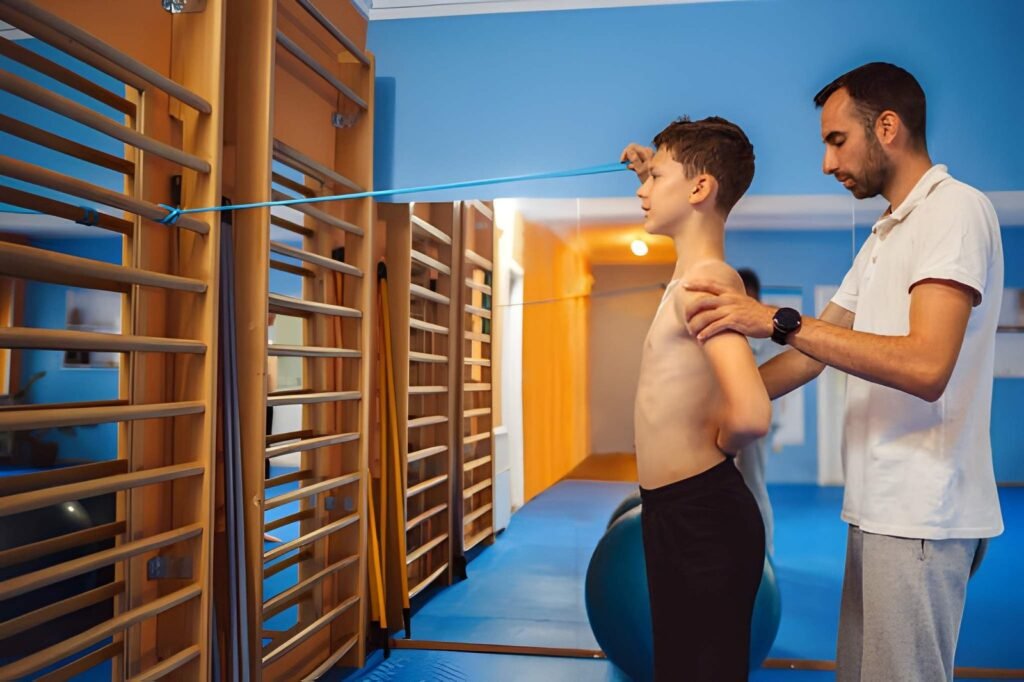
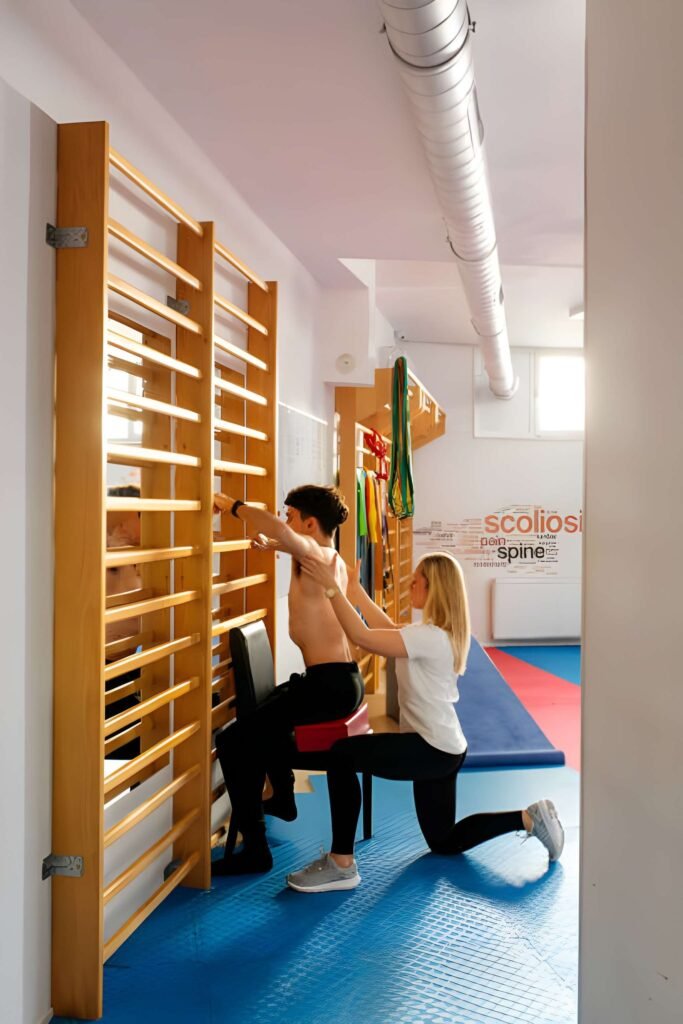
You'll work through your PSSE program in supervised one-on-one sessions at our Youngsville clinic. Each session builds progressively — introducing new corrections, refining your technique, and advancing exercise difficulty as your awareness and control improve. We monitor your progress closely and adjust your program based on how your body responds.
Home Program & Long-Term Self-Management
A core goal of PSSE is to empower you to manage your own scoliosis long-term. You will leave each session with a clear, practical home exercise program that reinforces what you have learned in the clinic. Over time, your PSSE exercises become a part of your daily routine — providing lasting postural correction and curve stabilization independently of ongoing clinic visits.
What PSSE Can Do for You
6 Evidence-Based Benefits of Physiotherapeutic Scoliosis Specific Exercises
Clinical research and decades of patient outcomes consistently show that a structured PSSE program — particularly one using the Schroth Best Practice Method — delivers meaningful, measurable improvements across multiple dimensions of scoliosis management.
Slows or Halts Curve Progression
In adolescent patients, consistent PSSE practice has been clinically shown to significantly slow the rate of curve progression — reducing the likelihood of reaching surgical thresholds and, in many cases, avoiding bracing altogether.
Improves Postural Symmetry
PSSE teaches patients to actively correct their posture in daily life — reducing visible postural asymmetry, trunk rotation, rib prominence, and shoulder or hip unevenness associated with scoliosis.
Reduces Pain & Discomfort
Both adolescent and adult scoliosis patients report meaningful reductions in back pain, muscle fatigue, and discomfort following a structured PSSE program — as curve-related muscle imbalances are addressed and alignment improves.
Enhances Breathing Capacity
Rotational Angular Breathing (RAB) — a core component of Schroth-based PSSE — directly expands the concave side of the rib cage, improving thoracic mobility and increasing lung capacity in patients with thoracic scoliosis.
Builds Curve-Specific Muscle Strength
PSSE activates and strengthens the specific muscle groups needed to stabilize and support the corrected spinal position — creating a strong, balanced muscular foundation that reinforces postural correction throughout daily activities.
Empowers Long-Term Self-Management
Unlike passive treatments, PSSE gives patients the tools to manage their own condition independently. A well-established home program means patients can maintain their progress and prevent deterioration long after formal clinic sessions conclude.
How Rotational Angular Breathing Works
RAB is a signature technique of the Schroth Method. Patients learn to direct their breath into the collapsed, concave areas of the rib cage — expanding restricted spaces from the inside out. Combined with postural corrections, this three-dimensional breathing actively de-rotates the spine and rib cage while improving respiratory function.
Start Your Scoliosis Rehabilitation Today
Ready to Take Control of Your Scoliosis?
PSSE is one of the most effective non-surgical tools available for scoliosis management — but results depend on early action and consistent, expert-guided practice. Book your initial scoliosis evaluation at Polaris Rehabilitation today and take the first step toward better posture, less pain, and a stronger spine.
Serving Youngsville, Wake Forest, Franklinton & greater Franklin County, NC.